F is for Five Eyes
F is for Five Eyes
(From the A-Z of Secrecy and Ignorance Series)
Lydia Morgan, Associate Professor, Birmingham Law School, University of Birmingham
Secrecy at state level can be the result of agreements between states. The secret intelligence sharing alliance between the ‘Five Eyes’ (FVEY) – the UK, USA, Canada, Australia and New Zealand – is the archetypical secret alliance. With a name derived from the shorthand for ‘UK/US/AUS/CAN/NZ Eyes Only’, FVEY was borne of a secret agreement and persists behind classification making its legal status evasive, both internationally and nationally. The alliance has remarkable durability but also disrupts legal standards, seemingly enables circumvention of domestic legal protection, and has galvanised expansion of bulk surveillance. As soft law, the FVEY’s regulatory status has seen some comparative assessment that underscores what might be its greatest weakness, its asymmetry. FVEY offers to secrecy studies a long-standing multi-lateral arrangement that occasionally enters judicial and public consciousness but otherwise quietly operates unopposed.
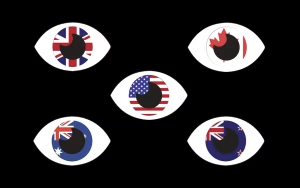
Initially an agreement between Britain and the USA in 1946, the formalised UKUSA Agreement 1956 covering all five nations, was eventually declassified in 2010 following investigative reporting which revealed its existence (Norton-Taylor [2010]; Kerbaj [2019]). It remains a secret alliance as while the primary agreement is publicly available, both the subsequent and current agreement is not, impeding comprehensive assessment of its status (Kerbaj [2019] Couch [2019]). With Canada formally joining in 1948 (CANUSA 1948) and Australia and New Zealand in 1956, FVEY was able to access intelligence from across vast swathes of the world (Aldrich [2001] 75, 76, 77; Kealey and Taylor [2021] 22-44). The partners are not necessarily equal in status as the UK was listed first to acknowledge her access to intelligence networks in her former ‘dominions’ even though the USA evidently holds leadership. Similarly, while the ‘collaborating Commonwealth countries’ clearly engaged strategic vision in joining, the ‘semi-feudal’ direction of antipodean SIGNIT operations from London is obscured (UKUSA [1956] Appendix J, para 7; O’Neil [2017]; Kealey and Taylor [2021] 23). FVEY is also the basis for a wide range of intelligence sharing networks such as such as ‘Five Eyes Plus 3 (FVEY+3)’ adding France, Germany and Japan; and the 14 Eyes Alliance or SIGINT Seniors Europe (SSEUR) with Denmark, France, the Netherlands, Norway Belgium, Germany, Italy, Spain and Sweden. Each iteration purportedly has distinct objectives. For example, FVEY+3’s strategic attention is China and Russia, whereas the ostensibly informal Counter-Terrorism Group (CTG) shares intelligence primarily about ‘Islamist’ terrorism (Guttman [2018]; Jirat [2020]; Fägersten [2016]). The CTG arose from the ‘cozy’ intergovernmental cooperation and intelligence exchange channel, Club de Berne, established in 1969 and later expanded to 17 European countries, the USA and Israel, to share information about Palestinian ‘terrorists’ through Kilowatt, an encrypted telegram system (Fägersten [2010] at 505, 515; Guttman [2025] 101; Jirat [2020]).
Limited information is available on the scope of the FVEY agreement – how much is shared with whom and when – and on methods of dispute resolution between partners. Other questions remain about how the agreement impacts domestic transparency and accountability arrangements. What we do know falls into three areas.
First, the FVEY Eyes is not considered to be international law. The multilateral agreement does not conform to treaty requirements, such as registration at the UN Secretariat pursuant to Article 102 of the UN Charter, nor signed and ratified as defined by Article 2.1 of the 1969 Vienna Conventions on the Law of Treaties. These conditions could not be fulfilled by a secret treaty, leaving FVEY in the murky area of non-treaty agreements, lacking binding legal effect but still holding significant political sway. Its remarkable persistence through the changing weathers of the international liberal democratic order is likely sustained through cooperation and willingness, but cannot dispel distinct questions about the FVEY’s internal hierarchy and relationship with non-state parties, such as the CTG. It also suggests there is no recourse to legal dispute resolution between the parties or common oversight body, even accounting for the establishment of the Five Eyes Intelligence Oversight and Review Council (FIORC, established in 2017). The asymmetry is a particular concern in the face of Trump administration’s incendiary approach to the US Constitutional order and distain for the delicate but peaceful international legal system.
Second, intelligence sharing is broad but not automatic, with ownership retained by the nation which generated the intelligence (referred to as ‘originator control’). Particularly debated following the Snowden leaks, the circumvention of domestic legal protections continues to be of concern (Couch [2019]; Scott [2025]; Christakis and Bouslimani [2021]). Couch [2019] argues FVEY potentially breaches the First Amendment of the US Constitution. Even where clear prohibitions against employing FVEY intelligence against their own citizens exist, these protections are neither absolute nor necessarily enforceable since identifying the originating state is difficult and you have to know a protection has been circumvented to challenge it (Scott [2025] 167-174). For example, ‘boomerang routing’, where domestic telecoms and internet traffic transits via a foreign country, leaves communications exposed to intelligence surveillance in the ‘foreign’ country (Clement [2016]). Although previously only listed agencies were covered, FVEY can potentially pull intelligence from a vast range of government agencies, as the 1956 amendments committed ‘the US and the UK as a whole not only the organisations represented on the two boards’ (GCHQ Records on UKUSA [1956]). Assuming that broad coverage continues across all partners, even a simplified view indicates at least 34 ‘core’ agencies.
Finally, actual friction between members, routes to dispute resolution and the agreement’s impact on the domestic transparency and accountability arrangements remain difficult to identify beyond Scott’s [2025] claim that the Commonwealth four show convergence in their approach to national security constitutionalism. It is evident the agreement underpins an assumption of a bond even when there is public tension. Whether this means the FVEY is stronger than quotidian irascible international relations or if there is a need to be alert to brittle power dynamics is unclear (O’Neil [2017]). New Zealand’s anti-nuclear stance in the 1980’s is a good case in point as it did not damage the Phantom Eye’s FVEY membership even if some suggested it was in peril (Battersby and Ball [2023] 926-929). That history need not mean that the alliance will survive more seismic shifts.
Complementing historical accounts from Kerbaj [2022], each Five Eyes jurisdiction has received healthy commentary. For example, Scott [2025] covers the UK; Forcese and West [2020], and Molinaro (ed) [2021] appraise Canada; Couch [2019]; Berman [2023] Leuprecht and McNorton [2021] reflect the USA’s more expansive national security assessment; O’Neil [2017] analyses Australia; and Battersby and Ball [2023] recently gave New Zealand, the ‘Phantom Eye’, a foothold in the commentary. Similarly, the ethics of intelligence production has developed its own academic sub-study (Vrist Ronn [2016]; Omand and Phythian [2018]). The growth of ‘hybrid’ accountability to accommodate intelligence material is studied by constitutional and public law scholars (e.g. Forcese and West [2020]; Woods, McNamana, and Townsend [2021]; Blackbourn [2021]; McGarrity and Hardy [2020]; Berman [2023]; Edgar [2017]; Donohue [2023]; Lane Scheppelle [2010]) and joins literature from security studies and history on intelligence cooperation (Molinaro (ed) [2021]; Pfluke [2019]; Andrew [1996]; Aldrich [2010]; Blaxland [2023]). But further study is warranted focusing on the Five Eyes comparatively as intelligence gathering and sharing continues to present dissonance for broadly democratic states, where expansive surveillance operations for wide, sometimes opaque purposes – the hallmark of authoritarian states – are now replete across liberal democracies, facilitated by surveillance capitalism (Zuboff [2019]).
Bibliography and Further Reading
Commission of Inquiry Concerning Certain Activities of the Royal Canadian Mounted Police (McDonald Commission, 1981)
Truman Memo, October 24, 1952 https://www.nsa.gov/Helpful-Links/NSA-FOIA/Declassification-Transparency-Initiatives/Historical-Releases/Truman/
The Report of the Iraq Inquiry (Report of a Committee of Privy Counsellors) (The Iraq/Chilcot Inquiry, 6 July 2016) <www.iraqinquiry.org.uk/the-report
UKUSA Agreement 1956, General Records of GCHQ (HW 80 4(A)(b), National Archives (UK), 10th October 1956, https://discovery.nationalarchives.gov.uk/details/r/C11536921
Aldrich, R, ‘GCHQ and Signit in Early Cold War, 1945-1970’ (2001) 16:1 Intelligence and National Security 67
Aldrich, R, GCHQ: The Uncensored Story of Britain’s Most Secret Intelligence Agency (HarperCollins 2010)
Andrew, C, ‘The Making of the Anglo-American SIGINT Alliance, 1940–1948’, in Dillard and Hitchcock (eds.) The Intelligence Revolution and Modern Warfare (Imprint Publications, 1996)
Battersby, J and Ball, R ‘The Phantom Eye: New Zealand and the Five Eyes’ (2023) 38:6 Intelligence and National Security 920-937
Berman, E, ‘Reimagining Surveillance Law’ (2023) U. ILL. L. REV. 1235
Blackbourn, J ‘Mechanisms for Reviewing and Monitoring National Security Laws: the UK and Australia Compared’ (2021) 95(10) Australian Law Journal, 786-797
Blaxland, J Revealing Secrets: An Unofficial History of Australian Signals Intelligence and the Advent of Cyber (UNSW Press, 2023)
Brazeal, G ‘Mass Seizure and Mass Search’ (2020) 22 U. PA. J. CONST. L. 1001
Chadwick, E ‘Terrorism and self-determination’ in Saul (eds) Research Handbook on International Law and Terrorism (2nd ed), (Edward Elgar, 2020) 285-299
Chesterman, S ‘Terrorism, surveillance and privacy’ in in Saul (eds) Research Handbook on International Law and Terrorism (2nd ed), (Edward Elgar, 2020) 411-422
Christakis, T and Bouslimani, K ‘National Security, Surveillance and Human Rights’ in Geiß and Melzer (eds) The Oxford Handbook of the International Law of Global Security (OUP 2021) 699-717
Clement, A ‘Addressing mass state surveillance through transparency and network sovereignty, within a framework of international human rights law – a Canadian perspective’ (2016) 23 Chinese Journal of Journalism and Communication Studies 31-52
Couch, B ‘Five Eyes: Unblinking, Unmoving, and out of Control’ (2019) 45 NC J Int’l L 25
Donohue, L.K. ‘Surveillance, State Secrets, and the Future of Constitutional Rights’ (2022) Sup. Ct. Rev. 351-411.
Edgar, T.H. ‘Beyond Snowden: Privacy, Mass Surveillance, and the Struggle to Reform The NSA’ (Brookings Institute, 2017)
Fägersten, B ‘Bureaucratic Resistance to International Intelligence Cooperation – The Case of Europol’ 2010 25(4) Intelligence and National Security 500–520
Fägersten, B ‘For EU eyes only?: Intelligence and European security’ European Union Institute for Security Studies (EUISS) (2016)
Farmer, R ‘School for Aust. spies: Top-Secret Espionage Ring Exposed’, The Daily Telegraph, 1 November 1972
Forcese, C and West, L National Security Law (2nd Ed) (Irwin Law, 2020)
Golder, B and Williams, G, ‘What is ‘Terrorism’? Problems of Legal Definition’ (2004) 27 University of New South Wales Law Journal 270
Goodman, MS ‘Evolution of a Relationship: The Foundations of Anglo-American Intelligence Sharing’ (2015) 59(2) Studies in Intelligence
Goot, M ‘Questions of deception: contested understandings of the polls on WMD, political leaders and governments in Australia, Britain and the United States’ (2007) 61(1) Australian Journal of International Affairs 41–64
Greene, A ‘Defining Terrorism: One Size Fits All?’ (2017) 66(2) International and Comparative Law Quarterly 411-440
Guttmann, A ‘Combatting Terror in Europe: Euro-Israeli Counterterrorism Intelligence Cooperation in the Club de Berne (1971–1972)’ (2018) 33(2) Intelligence and National Security 158–75
Guttmann, A ‘Manipulating Friends: Mossad’s Covert Operations and Disinformation in Europe’ (2025) 60(1) Journal of Contemporary History 99-115
Jirat, J ‘The Club de Berne’ About:Intel (1st April 2020) https://aboutintel.eu/the-club-de-berne/
Kealey, GS and Taylor, KA, ‘After Gouzenko and “The Case”: Canada, Australia, and New Zealand at the secret Commonwealth Security Conferences of 1948 and 1951’ in Molinaro (ed) The Bridge in the Parks: The Five Eyes and Cold War Intelligence (U of Toronto, 2021)
Kerbaj, R The Secret History of the Five Eyes: The Untold Story of the International Spy Network (John Blake, 2022)
Lane Scheppele, Kim, ‘The international Standardisation of National Security Law’ (2010) 4 National Security Law and Policy 437
Leuprecht, C and McNorton, H. Intelligence as democratic statecraft: Accountability and governance of civil-intelligence relations across the Five Eyes security community-the United States, United Kingdom, Canada, Australia, and New Zealand. (OUP 2021)
Mavronicola, N, ‘Institutionalized inhumanity: from torture to assassination’ in Geiß and Melzer (eds), Oxford Handbook on the International Law of Global Security (OUP 2021)
McGarrity, N and Williams, G ‘From Convert to Coercive: A new model of surveillance by intelligence agencies’, in Davis, McGarrity and Williams (ed) Surveillance, Counter-Terrorism and Comparative Constitutionalism (Routledge 2014) 234-251
McGarrity, N, & Hardy, K ‘Digital surveillance and access to encrypted communications in Australia’ (2020) 49(3-4) Common Law World Review 160-181
McKay, S and Walker, C ‘Intelligence law in the United Kingdom’ in Dietrich, J-H. et al, Reform der Nachrichtendienste zwischen Vergesetzlichung und Internationalisierung (Mohr Siebeck, Tübingen, 2019) 119-128
Molinaro, D.G (ed) The Bridge in the Parks: The Five Eyes and Cold War Counter-Intelligence ( University of Toronto Press, 2021)
Norton-Taylor, R, ‘Not So Secret: Deal at the Heart of UK-US Intelligence’ The Guardian (London, June 24, 2010) https://www.theguardian.com/world/2010/jun/25/intelligence-deal-uk-us-released
O’Neil, A ‘Australia and the ‘Five Eyes’ intelligence network: the perils of an asymmetric alliance’ (2017) 71:5 Australian Journal of International Affairs, 529-543
Omand, D, and Phythian, M Principled spying: The ethics of secret intelligence (OUP, 2018)
Pfluke, C ‘A history pf the Five Eyes Alliance: possibility for reform and additions’ (2019) 38 Comparative Strategy 302
Richards, J ‘Intelligence and CounterTerrorism’ in Silke (ed) Routledge Handbook of Terrorism and Counterterrorism (Routledge 2018) 395
Roach, K The 9/11 Effect: Comparative Counter-Terrorism (CUP, 2011)
Scott, PF National Security Constitutionalism in the Commonwealth Five Eyes States (Hart, 2025)
Saul, B, ‘The Curious Element of Motive in Definitions of Terrorism: Essential Ingredient –
Or Criminalising Thought?’ (2008) 08/123 University of Sydney, Sydney Law School Legal Studies Research Paper
Scheinin, M and Vermuelen, M ‘Intelligence cooperation in the fight against terrorism through the lens of human rights law and the law of state responsibility’ in Born, Leigh and Wills (eds), International Intelligence Cooperation and Accountability (Routledge, 2011)
Sevastopulo, D and Gridneff, I ‘White House official pushes to axe Canada from Five Eyes intelligence group, The Financial Times (London, Feb 25 2025)
Vrist Ronn, K ‘Intelligence Ethics: A Critical Review and Future Perspectives’ (2016) 29(4) International Journal of Intelligence and CounterIntelligence 760-784
Walker, C ‘Keeping Control of Terrorists Without Losing Control of Constitutionalism’ (2007) 59(5) Standford Law Review 1395
Walsh, P and Miller, S (2016) ‘Rethinking ‘Five Eyes’ Security: Intelligence Collection Policies and Practice Post Snowden’, 31:3 Intelligence and National Security 345
Wark, W ‘The Road to CANUSA: How Canadian Signals Intelligence Won Its Independence and Helped Create the Five Eyes’ (2019) 35(1) Intelligence and National Security 29
Woods, L, McNamara, L and Townsend, J ‘Executive Accountability and National Security’ (2021) 84(3) Modern Law Review 553
Zuboff, S, The Age of Surveillance Capitalism (Profile, 2018)