See also ‘Born secret’
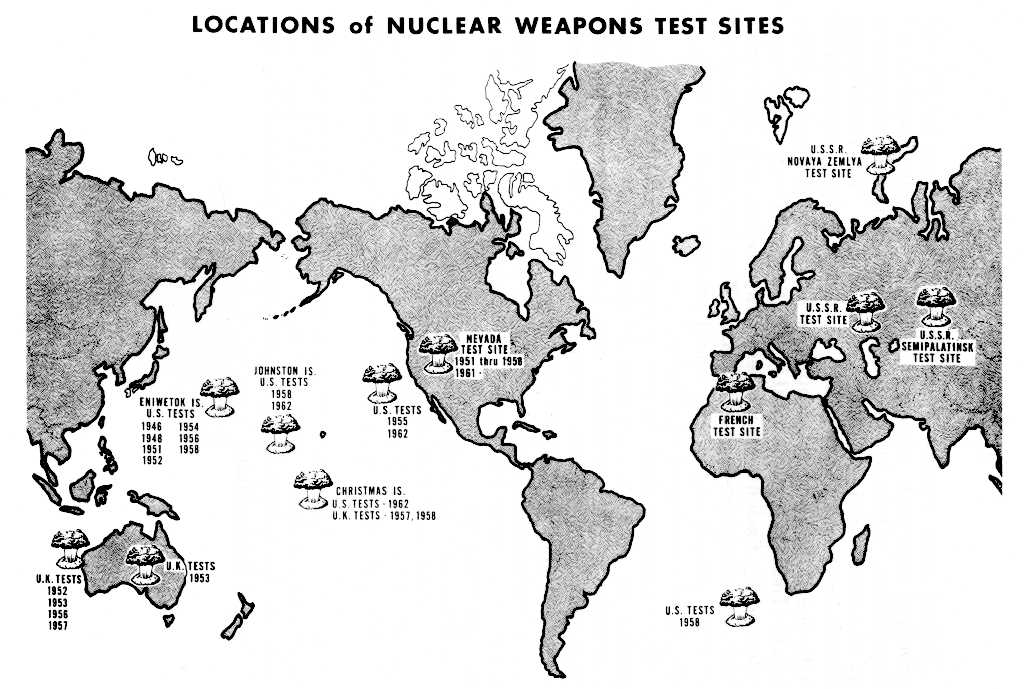
Secrecy regarding all things nuclear is inextricably bound up with historical policies, the declassified archive, law, regulations, and practices related to protecting military strategy and national security. In the United States, the dawn of atomic (fission) and nuclear (fission and fusion) secrecy rests with the Manhattan Engineering District, whose research and development during World War II led to the use of the atomic bomb. The bomb held the “best kept secrets of the war” (Hewlett 1980). Since the advent of nuclear bomb technology, secrecy has moderated public understanding of atmospheric testing within the United States and around the globe; the details of human radiation experiments conducted during the Cold War, for example, were not released until the Clinton administration (Advisory Committee on Human Radiation Experiments 1995).
Nuclear secrecy, while imposing boundaries on public access to information, also restricts information to government officials to a need to know basis, dividing “the world into many compartments” (Teller 1970, p.142). While nuclear secrecy “does not refer to a single goal, practice, or institution” (Wellerstein 2021, p. 5) many, if not most governments strategically guard nuclear-related information.
But what is nuclear secrecy? There is not one universally adopted definition but this type of concealment and restriction of atomic (fission) and nuclear (fission and fusion) information may be generally characterized as
The intentional blocking, compartmentalizing, concealing, controlling distorting, hoarding, censoring, and manipulation of information related to the numerous dimensions of the atomic age, including nuclear fuel cycle activities, radiation risk, public health, emergency preparedness, pollution, waste, spying, war, and weapons development.
I base this definition on Sissela Bok’s (1989) work on secrecy as the intentional concealment and blocking of information; sociologist Edward Shils’ (1956) idea of secrecy as the “compulsory withholding of knowledge, reinforced by the prospects of sanctions for disclosure”; Steven Aftergood’s (2000) characterization of specific types of secrecy and developments involving reclassification of Cold War weapons data; Alperovitz (1995) especially chapter 48, “Censorship and Secrecy.” This definition is also based on the penalties for disclosure of “atomic” information under the U.S. Atomic Energy Act of 1948 and 1954, as well as the laws of other countries (the UK and Russian Federation, for example).
Furthermore, nuclear secrecy is institutionalized through bureaucratic organization, statute, regulation, decree, security classification of information, language (Kinsella 2005), control of the media, and informal governmental practices. The violation or leaking of nuclear-related information carries with it penalty for disclosure. Harassment, monetary fines, and incarceration under official secrecy laws have been utilized to silence individuals. This aspect of secrecy has “disciplinary effects on individuals who are incorporated into nuclear institutional systems”, targeting them with “disciplinary power as conceptualized by Foucault” (Kinsella 2005, p. 63), thereby preventing even the conception of disclosures.
Finally, nuclear secrecy has implications for history, diplomacy, public memory, right to information, and justice. The examples below illustrate the range of nuclear secrecy and its connection to deliberate concealment, censorship and control of information:
References
Advisory Committee on Human Radiation Experiments. 1995. Chapter 13: The practice of secrecy.
https://ehss.energy.gov/ohre/roadmap/achre/chap13_3.html
Aftergood, S. 2000. “Secrecy is back in fashion.” Bulletin of the Atomic Scientists 56, no. 6: 24-30. https://journals.sagepub.com/doi/pdf/10.2968/056006009
Alperovitz, G. 1995. The decision to use the atomic bomb and the architecture of an American myth. New York: Knopf.
Amerisov, A. 1986. “A chronology of Soviet media coverage,” Bulletin of Atomic Scientists, 42: 7, 38-39, DOI: 10.1080/00963402.1986.11459403
Bok, S. 2011. Secrets: On the ethics of concealment and revelation. New York: Vintage.
Gorbachev, M. 1995. Memoirs. Trans. W. J. Siedler. New York: Doubleday.
Hewlett, R. G. 1980. “The ‘born-classified’ concept in the U.S. Atomic Energy Commission,” December 22, 173-187. House Committee on Government Operations. The government’s classification of private ideas: Thirty-fourth report together with additional views. 96th Congress, 2d session, House of Representatives. Washington, DC: https://www.govinfo.gov/content/pkg/SERIALSET-13382_00_00-057-1540-0000/pdf/SERIALSET-13382_00_00-057-1540-0000.pdf
Kinsella, W. J. 2005. “One hundred years of nuclear discourse: Four master themes and their implications for environmental communication.” In The environmental communication yearbook v.1 (pp. 49-72), edited by S. L. Senecah. New York: Routledge.
Lemaître, R. 2005. How closed cities violate the freedom of movement and other international human rights obligations of the Russian Federation, Institute for International Law, Working Paper No. 77. https://www.law.kuleuven.be/iir/nl/onderzoek/working-papers/WP77e.pdf
Luke, T. W. 1989. Screens of power: Ideology, domination, and resistance in informational society. Urbana: University of Illinois Press.
Neier, Aryeh, “USA:‘born classified’,” Index on Censorship 9, no. 1 (1980): 51-54.
Shils, E. 1956. The torment of secrecy. Glencoe, IL: The Free Press.
Teller, E. 1970. “The problems of secrecy.” National Classification Management Society Journal 6, 136-143.
Wellerstein, A. 2021. Restricted data: The history of nuclear secrecy in the United States. Chicago: University of Chicago Press.